

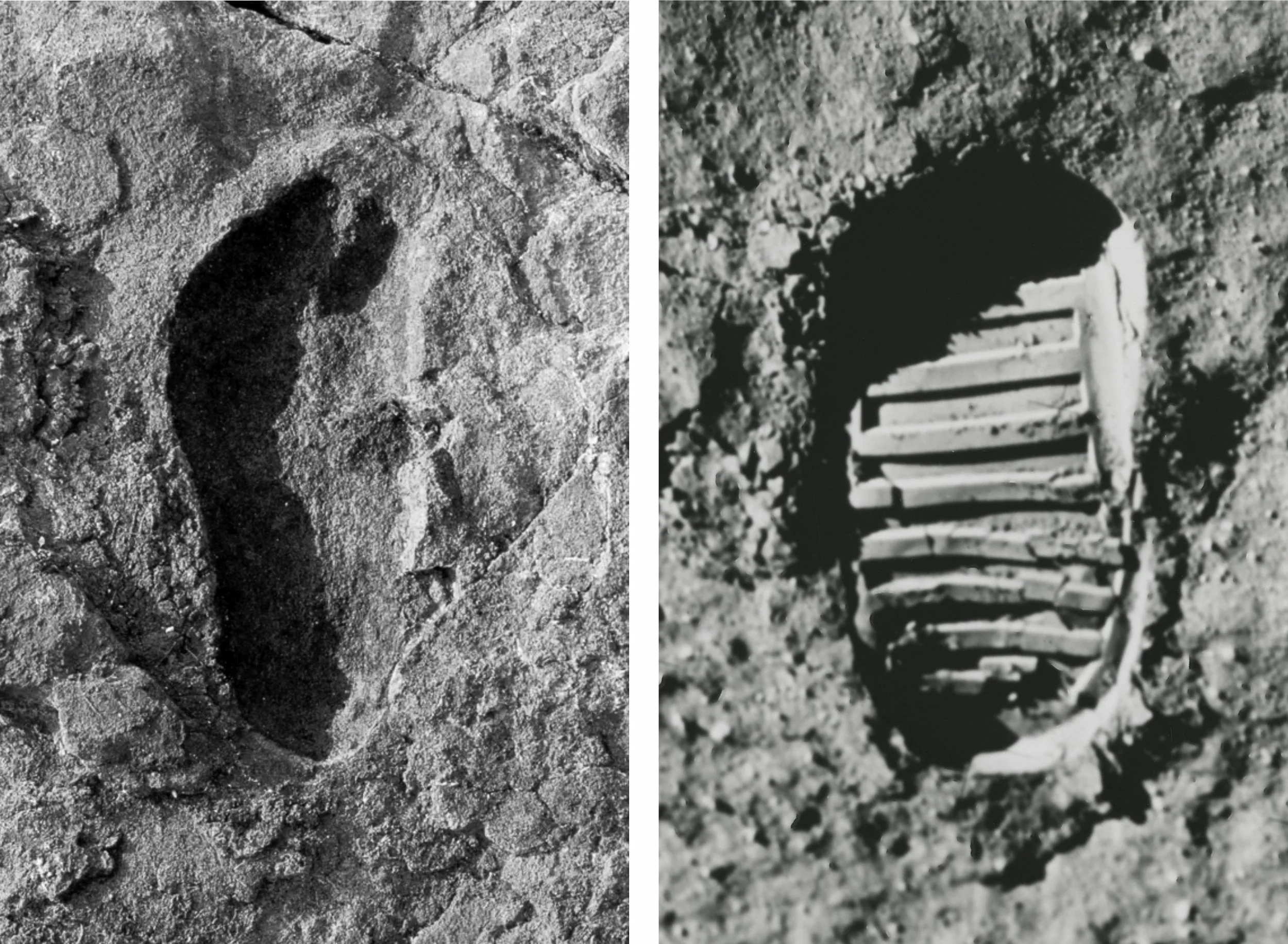
Etched into a 5D Memory Crystal bound for deep space, this depiction of the earliest known hominin footprint was left in Laetoli, Tanzania some 3.66 million years ago.
Footprints mark turning points in the story of our species.
Preserved in volcanic ash and discovered in 1976, the print belonged to Australopithecus afarensis, an upright-walking hominin that existed long before the rise of Homo sapiens. Its anatomy—heel-strike, toe-off, and a forward stride—reveals a fundamental truth: before tools, language, or fire, we walked. These early steps in our long journey are literal and metaphoric illustrations of intention, curiosity, and a want to explore.
Our intentions, curiosities, and explorations became increasingly artistic, spiritual, and inventive. We started to paint stories. We sang songs together, and communities began to cook in groups. We began to search for greater meaning, looking for answers in all corners of nature, including within ourselves and the cosmos. At some point, we began to dance in order to be in union with this greater meaning. Feet had a new purpose. We began to invent tools to help us explore. We made shoes, boats, airplanes, and rockets.
As part of a LifeShip mission, this etched image carries digitized artworks from contemporary creators. With this, our oldest known mark contains our most current artistic expressions. All of this is sent into the cosmos using the most advanced exploration technology. The individual who left this footprint would never have imagined how far humans have gone. We should never lose sight of our past. We should always embody this awe. We should always remember that we are only getting started.
Concept credit: Ethan Rainbolt from The Studio of Samuel Stubblefield
Artwork image and narrative credit: Samuel Stubblefield
Thanks to The Smithsonian Institution and AstroForge
Special thanks to Ben Haldeman and LifeShip
Spacecraft image: AstroForge